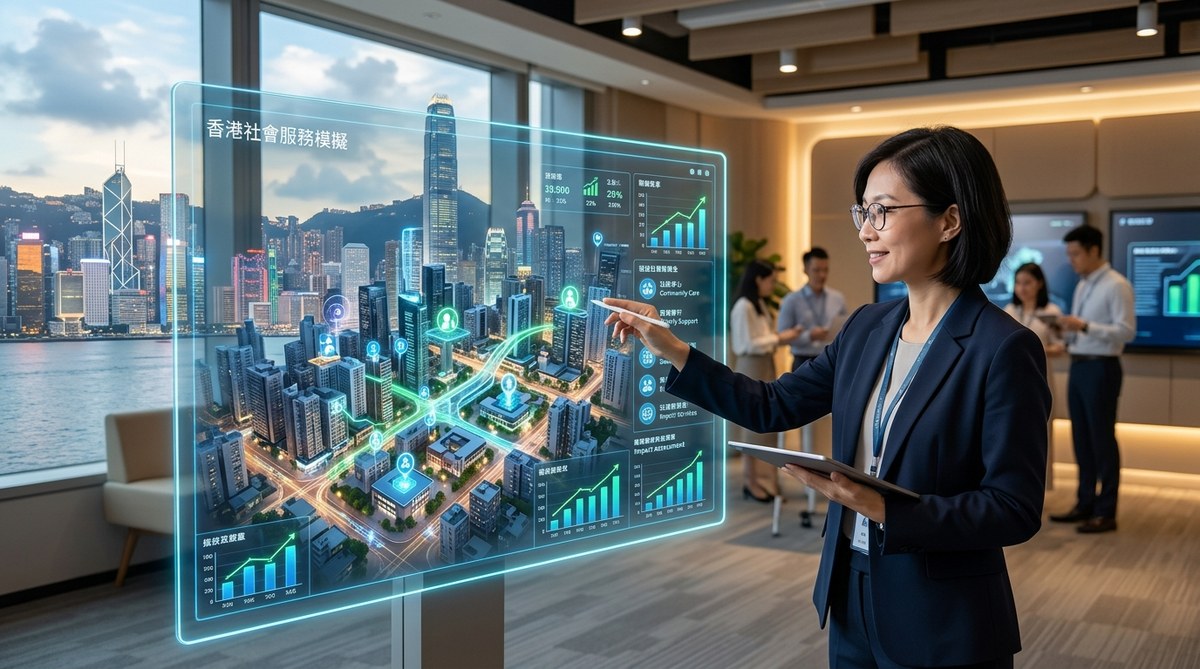
Imagine testing a new outreach programme for elderly residents in Sham Shui Po without spending a single dollar on staffing, transport, or venue hire. What if you could see, before launching, exactly how many people would be reached and which services would have the greatest effect? That is the promise of digital twin technology, and a growing number of Hong Kong NGOs are already using it to simulate social service impact.
Digital twins let Hong Kong NGOs build a virtual copy of their service network, run simulations, and predict outcomes before real-world deployment. This guide covers how local organisations are using the technology, the steps to get started, common pitfalls to avoid, and what the future holds for data-driven social services in the city.
What Is a Digital Twin for Social Services?
A digital twin is a virtual model that mirrors a real-world system. In engineering, it is used to simulate a jet engine or a factory floor. In Hong Kong’s social sector, it is a data-driven replica of a service network. The model ingests information about client demographics, service locations, staffing levels, funding flows, and community needs. It then runs simulations to show how changes in one area affect the whole system.
Think of it as a flight simulator for social work. You can test what happens if you add two caseworkers in Kowloon East, or if funding for after-school tutoring shifts to Central. The twin does not guess. It uses real data to produce realistic scenarios.
Why Hong Kong NGOs Need This Now
Hong Kong faces unique social challenges. The city has a dense population, an ageing demographic, and a complex mix of public, private, and charitable service providers. Space is tight. Funding is competitive. Every dollar must count.
Traditional planning methods rely on past reports and intuition. They cannot easily account for the ripple effects of a decision. A digital twin can. For example, if an NGO in Wong Tai Sin wants to reduce waiting times for counselling, the twin can simulate how shifting two staff members from intake to counselling sessions cuts the queue. It can also show the knock-on effect on intake delays.
This kind of insight is gold for social service managers, NGO directors, and policy researchers who need to demonstrate impact to donors and government bodies. The Empowering Hong Kong’s Social Services with Innovative Technology Solutions article covers more ways tech is reshaping the sector.
How Digital Twins Work in Practice
Building a digital twin is not as complex as it sounds. Here is the process most Hong Kong NGOs follow.
-
Define the system boundaries. Choose a specific service, programme, or geographic area. For example, a meals-on-wheels service for seniors in Southern District. Do not try to model everything at once.
-
Gather and clean the data. Collect historical records on client numbers, service times, costs, and outcomes. Data quality matters. Garbage in, garbage out. Many NGOs use their existing case management systems as a starting point.
-
Build the model. Use a digital twin platform or work with a data partner. The model maps relationships between inputs (staff hours, funding) and outputs (meals delivered, client satisfaction).
-
Validate the twin. Run the simulation against past data to see if it accurately predicts what actually happened. Adjust the model until it matches reality within an acceptable margin.
-
Run scenarios. Change one variable at a time. What happens if funding drops by ten percent? What if you add a new route for meal delivery? The twin shows the likely outcome.
-
Make decisions and monitor. Use the insights to guide real-world changes. Then feed new data back into the twin to keep it accurate.
Real Applications in Hong Kong
Several local NGOs are already using digital twins in creative ways.
-
Elderly care routing. One organisation serving the Central and Western district built a twin of its home visit schedule. It optimised travel routes, cutting fuel costs by 15 percent and allowing two extra visits per day.
-
Youth programme placement. A charity running after-school classes in Kwun Tong used a twin to match students with classes based on location, availability, and learning needs. Attendance improved by 22 percent.
-
Food bank inventory. A food bank serving multiple districts modelled supply and demand. The twin helped them predict shortages before they happened, reducing waste by 30 percent.
These examples show that digital twins are not just for big corporations. They are practical tools for any NGO that manages resources and wants to do more with less. For more on how data is driving change, see How Hong Kong Social Services Can Use Data Analytics to Improve Impact in 2026.
Common Mistakes to Avoid
Even well-intentioned projects can go wrong. Here is a table of common mistakes and how to avoid them.
| Mistake | Why It Happens | How to Avoid It |
|---|---|---|
| Modelling too much too soon | Excitement leads to an overly complex twin that is hard to validate | Start small. Pick one service or one district. |
| Using poor quality data | Legacy systems have gaps or errors | Clean and standardise data before building the model. |
| Ignoring staff input | Frontline workers know the real workflow | Involve caseworkers and drivers in the design process. |
| Treating the twin as a one-off project | The model becomes outdated if not updated | Schedule regular data refreshes and retrain the model quarterly. |
“A digital twin is not a magic crystal ball. It is a tool that reflects the quality of the data you put in. The best twins are built by teams that include both data scientists and frontline social workers.”
Dr. Emily Kwok, Director of Social Innovation at a Hong Kong university
The Technology Stack Behind a Digital Twin
You do not need a multi-million dollar IT department. Many Hong Kong NGOs use a combination of these tools:
- Data integration platforms like Microsoft Power BI or Tableau to pull data from different sources.
- Simulation software such as AnyLogic or Simul8 for building the model.
- Cloud storage (AWS, Google Cloud, or Azure) to host the data securely.
- APIs to connect the twin to live data from case management systems.
Some organisations partner with local universities or tech firms that offer pro-bono support. The Essential Tech Tools Every Hong Kong Nonprofit Should Implement guide has a longer list of practical tools.
Building the Case for Funding
Funders love evidence. When you can show that a digital twin simulation predicted a 12 percent improvement in service reach, you have a powerful story for your next grant application. Here are a few tips:
- Frame the twin as a risk-reduction tool. It helps you avoid costly mistakes.
- Emphasise that the twin can model “what if” scenarios for funders. For example, “If you fund an additional social worker, here is the projected impact on waiting times.”
- Use the twin to generate visual reports that are easy for non-technical donors to understand.
A Three-Month Roadmap for Getting Started
If you are ready to try a digital twin, here is a realistic timeline.
- Month 1: Discovery. Identify the problem you want to solve. Gather a small team. Map your data sources.
- Month 2: Build a prototype. Use a simple model with one variable. Validate it against historical data.
- Month 3: Run your first simulation. Test one scenario. Share the results with your team. Decide whether to expand the model.
Do not aim for perfection. Aim for a useful first version. You can always refine it later.
What the Future Holds
Digital twins in Hong Kong’s social sector are still early stage. In the next few years, we will likely see:
- Real-time twins that update automatically from IoT sensors in care homes or community centres.
- Twins that integrate with AI to suggest optimal resource allocation without human input.
- Shared twins where multiple NGOs in a district collaborate on a single model to coordinate services.
These advances will make social services more proactive and less reactive. The Digital Innovations Driving Greater Impact in Hong Kong’s Social Services in 2026 article explores what is coming next.
Start Small, Think Big
Digital twins are not science fiction. They are a practical, data-driven way to make better decisions for the communities Hong Kong NGOs serve. You do not need a huge budget. You need a clear question, good data, and a willingness to test ideas in a virtual sandbox before rolling them out in the real world.
Pick one service. Build a simple model. Run one simulation. See what you learn. That first step could change how your organisation plans for the future.