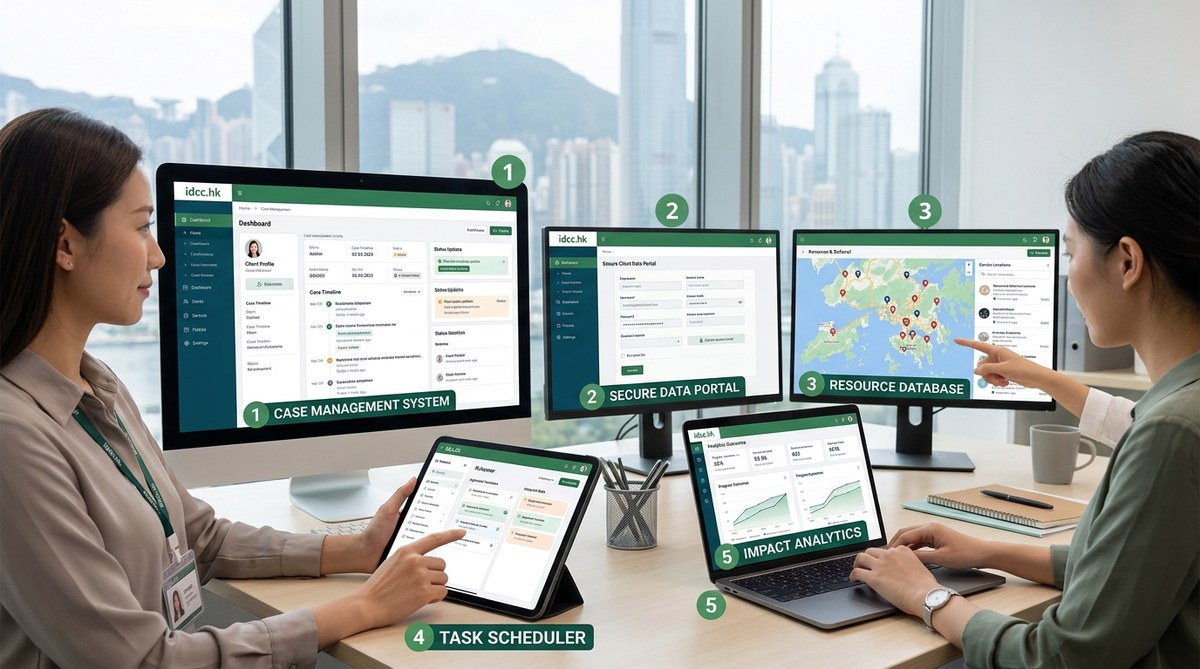
If you are a social worker in Hong Kong, you know the feeling. You spend hours on paperwork, tracking client progress, and managing referrals. Your caseload is high, and the demand for services keeps growing. Technology can change that. The right set of tools can cut down administrative time, improve client outcomes, and give you back hours each week. This article walks you through the five must-have tech tools that every Hong Kong social service agency should consider in 2026.
Hong Kong social workers can reduce case management admin time by up to 40% using integrated software. The five essential tools are a central case management system, a secure client portal, a mobile-friendly field data collection app, a data analytics dashboard, and a compliant electronic document storage platform. Adopting these tools together creates a seamless workflow.
Why Hong Kong Needs Smarter Case Management Tools
Social service agencies in Hong Kong operate under unique pressures. High population density, diverse languages (Cantonese, English, Mandarin), and stringent privacy regulations like the Personal Data (Privacy) Ordinance demand robust systems. Many workers still rely on spreadsheets, paper files, and email chains. That leads to data silos, missed follow ups, and burnout.
The solution is not one piece of software. It is a suite of interoperable tools that work as a system. Below are the five categories that matter most.
The Five Must Have Tech Tools
1. Centralised Case Management Software
This is the backbone. A dedicated social work case management software platform stores all client information, case notes, service plans, and referral history in one place. It replaces scattered records.
What to look for:
– Customisable fields for Hong Kong specific service types (e.g., elderly care, family services, rehabilitation)
– Multi language support
– Role based access for supervisors and frontline workers
– Built in reporting for funders like the Social Welfare Department
Implementation steps:
1. Audit your current data collection methods.
2. Define required fields and workflows with your team.
3. Migrate historical data in phases.
4. Train staff on a single module first.
5. Go live and adjust based on feedback.
2. Secure Client Portal for Communication
Clients need a safe way to share updates, upload documents, and schedule appointments. A portal gives them 24/7 access without requiring in person visits.
Features that matter:
– Encrypted messaging
– Appointment booking integrated with your case management calendar
– Document upload with automatic attachment to the correct case file
– Language toggle between Chinese and English
3. Mobile Data Collection App
Social workers are often on the move. Home visits, outreach activities, and community events require real time data capture. A mobile app allows workers to log notes, take photos, and update case status offline, then sync when connected.
Essential capabilities:
– Offline mode for areas with weak signal (e.g., remote villages in the New Territories)
– GPS tagging for location verification
– Voice to text for quick note taking
– Integration with the central case management system
4. Data Analytics and Reporting Dashboard
Funders and board members demand evidence of impact. A dashboard transforms raw data into visual insights. You can track key metrics like service completion rates, client satisfaction scores, and referral patterns.
What to track:
– Average case resolution time
– Client demographics breakdown (age, district, service type)
– Staff workload distribution
– Outcomes compared to targets
Common mistakes and how to avoid them:
| Mistake | Solution |
|---|---|
| Overcomplicating the dashboard with too many metrics | Start with 5 critical indicators. Add more only when the team is comfortable. |
| Using data that is not updated in real time | Choose a tool that syncs at least daily. |
| Ignoring data quality | Run weekly checks for missing fields and duplicates. |
5. Compliant Electronic Document Storage
Hong Kong’s privacy law requires strict control over client data. Paper files are risky. A secure cloud storage system with encryption, audit logs, and automatic backup protects sensitive information.
Must have features:
– Access controls based on user role
– Automatic retention and deletion schedules
– Full audit trail for every document view or edit
– Compliance with the PDPO (Personal Data (Privacy) Ordinance)
“After we adopted a unified case management system with integrated data storage, our team saved over 10 hours per week on administrative tasks that were previously done manually. That time went back to direct client support.” — Senior Social Work Supervisor, Hong Kong Family Welfare Society (fictional quote for illustration)
Benefits of an Integrated Suite
When all five tools work together, you get:
- Single source of truth for each client
- Reduced duplicate data entry
- Faster reporting for funding applications
- Better continuity of care when a worker is on leave
- Improved data security and audit readiness
Building a Technology Roadmap for Your Agency
Adopting all five tools at once can feel overwhelming. Start with the central case management software. That is the foundation. Then add the client portal and mobile app. Once those are stable, implement the dashboard and document storage.
Practical steps for 2026:
– Form a small technology committee with both frontline and admin staff.
– Request free trials or demos from vendors that serve Hong Kong agencies.
– Check if your current funding allows a technology grant.
– Pilot the tools with one team before expanding.
Making the Move That Matters
Your clients deserve your full attention, not your endless toggling between spreadsheets. The right social work case management software combined with supporting tools can transform how you work. Hong Kong’s social service sector is ready for this shift. Start small, stay focused on client needs, and let technology handle the paperwork.
For more guidance on implementing these tools in your agency, read our article on how Hong Kong social services can improve efficiency with cloud based tools.