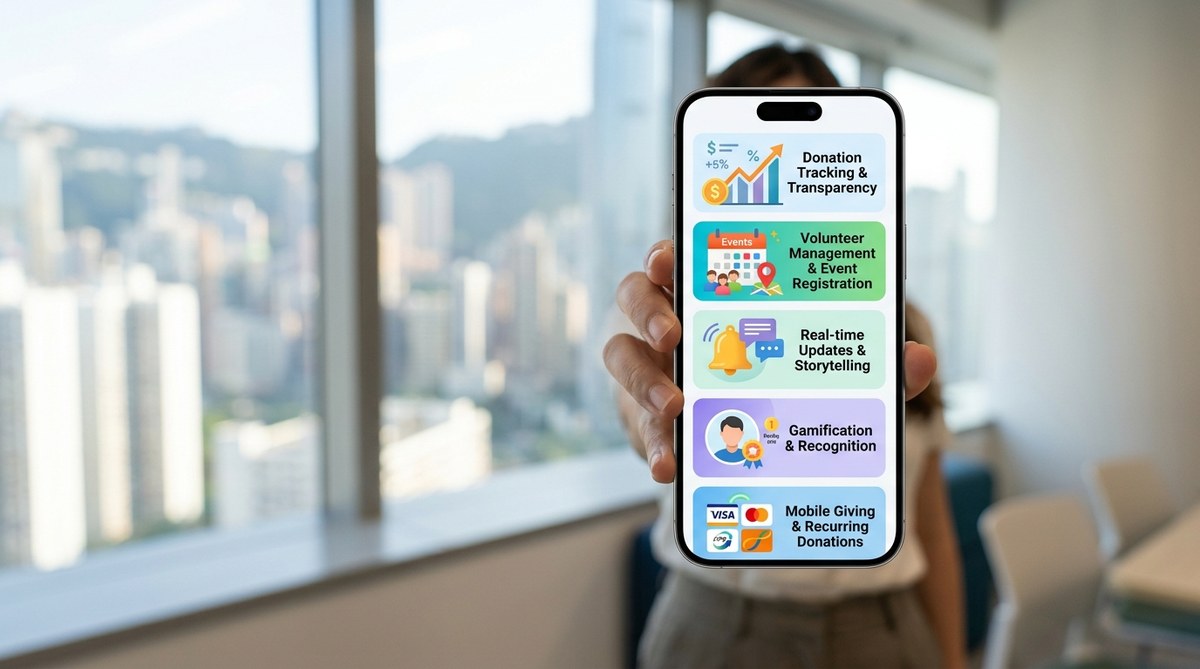
Your donors carry their phones everywhere. On the MTR, during lunch in Central, while waiting for the 101 bus in Wan Chai. That tiny screen is where their attention lives. And for Hong Kong nonprofits in 2026, that is exactly where meaningful engagement happens.
Mobile apps are no longer a nice to have. They are becoming the primary channel for donor communication, donation processing, and impact reporting across the city. From small charities in Sham Shui Po to large international NGOs with Hong Kong offices, organisations are discovering that a well designed app turns one time givers into lifelong supporters.
Hong Kong nonprofits are using mobile apps to move donors beyond one off donations. By layering in personalised impact stories, gamified giving circles, event booking, and transparent fund tracking, organisations build trust and repeat engagement. The goal is a frictionless experience that makes supporting your cause feel natural, rewarding, and deeply personal.
Why Mobile Apps Matter for Hong Kong Nonprofits Right Now
Think about how your donors live. They check Octopus balances on their phone. They order takeout via apps. They book taxis, pay bills, and chat with friends all from a single device. Your nonprofit needs to be in that same flow.
Hong Kong has one of the highest smartphone penetration rates in the world. According to recent data, over 93 percent of adults in the city own a smartphone. That means almost every person in your donor database carries a direct line to your organisation, if you give them a reason to stay connected.
Email open rates have dropped across most sectors. Social media algorithms limit organic reach. But a mobile app sits on the home screen, sending push notifications that actually get seen. For fundraisers in Hong Kong, that direct access is gold.
Let us look at five specific ways Hong Kong nonprofits are putting mobile apps to work.
1. Personalised Impact Stories That Land Every Time
Donors do not want generic thank you messages. They want to see exactly what their HKD 500 achieved. Did it fund school supplies for a child in Kennedy Town? Did it cover a week of meals for an elderly resident in Tai Po?
Several Hong Kong charities now use their mobile apps to deliver hyper personalised impact updates. When a donor gives, the app logs that gift and, a few weeks later, pushes a story tied directly to their contribution.
For example, a food bank based in Kwun Tong sends a short video update through its app showing the exact number of meal boxes delivered in the donor’s name. Another organisation focused on youth mentorship shares a photo and a handwritten note from a student, sent straight to the donor’s phone.
This approach works because it mirrors how people in Hong Kong already consume content: in short, visual bursts on their phone. The app becomes a window into the real work, not just a donation portal.
If you want to build this kind of personalised experience, start by mapping your donation amounts to specific outcomes. Then use your app to deliver those stories automatically. The technology exists. The hard part is committing to transparency.
2. Gamified Giving Circles and Peer to Peer Campaigns
Hong Kong loves a challenge. Look at how the city embraces step counting competitions, marathon fundraising, and workplace charity drives. Mobile apps tap into that same competitive energy.
Some nonprofits are building giving circles right inside their apps. A donor can invite friends, set a group goal, and watch a shared progress bar fill up. Others use leaderboards that show which team raised the most during a campaign.
One environmental group in Hong Kong ran a plastic free July challenge through its app. Participants logged their daily plastic usage, earned badges, and unlocked bonus donations from corporate sponsors. The app sent weekly roundups showing how the community performed. Engagement rates during that campaign were four times higher than their usual email based appeals.
The key insight here is that social proof matters in Hong Kong. When donors see their peers participating, they want to join. A mobile app makes that visibility effortless.
3. Seamless Event Booking and Check In
Nonprofits in Hong Kong host a lot of events. Gala dinners, charity runs, community workshops, fundraising auctions. Managing tickets, RSVPs, and on site check in can be chaotic without the right tools.
Apps solve this by combining everything in one place. Donors browse upcoming events, register with a single tap, and store their ticket digitally. On the day, they check in by scanning a QR code from the app. No printed tickets. No lost emails. No long queues at the registration desk.
A children’s charity in Sai Kung uses its app to manage an annual family fun day. Parents register their kids for activities, buy raffle tickets, and receive push reminders about event timing. The charity reports a 40 percent reduction in no show rates since launching the app based check in system.
Beyond convenience, events inside apps create a closed feedback loop. After an event, the app can automatically ask for a rating, collect photos, and suggest the next activity. That continuous engagement keeps donors warm between campaigns.
4. Transparent Fund Tracking in Real Time
Hong Kong donors are increasingly savvy. They want to know where their money goes before they give. This is especially true for younger donors, Gen Z and younger millennials, who research organisations carefully before opening their wallets.
Several local nonprofits now publish live fund tracking dashboards inside their mobile apps. A donor can see exactly how much has been raised for a specific project, how much has been spent, and what milestone the project has reached.
For instance, a charity building community kitchens in Hong Kong’s subdivided flats shows a progress bar for each kitchen. When donations hit a target, the app notifies everyone who contributed with a photo of the completed kitchen. No waiting for an annual report. The information is live and always accessible.
This level of transparency builds trust faster than any marketing campaign. It also reduces the burden on your communications team. Instead of answering individual donor questions, you direct them to the app where the data speaks for itself.
For more ideas on strengthening donor confidence, check out our guide on harnessing technology to boost transparency in Hong Kong charities.
5. Recurring Giving That Does Not Feel Like a Subscription
Recurring donations are the backbone of sustainable fundraising. But asking someone to sign up for a monthly auto debit can feel cold. Mobile apps help warm up that process.
Smart nonprofits in Hong Kong frame recurring giving as a membership, not a subscription. A donor joins a monthly giving circle inside the app. They receive exclusive content: behind the scenes videos, early access to events, a digital badge they can share on social media.
The app sends a friendly push notification before each charge: “Your monthly gift to Hope Kitchen goes out tomorrow. Here is what you helped achieve last month.” That small update reframes the transaction from a passive deduction to an active choice.
One organisation saw a 25 percent increase in recurring donor retention after introducing an app based monthly giving program. The difference was the feeling of belonging. Donors felt like insiders, not ATMs.
Building Your Mobile App Strategy: A Practical Checklist
Before you jump into development, consider these essential steps. They apply whether you are building a custom app or using a white label solution.
| Stage | Key Action | Common Mistake to Avoid |
|---|---|---|
| Discovery | Survey your top 50 donors about what they want | Building features nobody asked for |
| Design | Keep the user flow under three taps per action | Adding too many menus and buttons |
| Content | Plan 3 months of push notifications upfront | Launching with no content calendar |
| Launch | Recruit 100 power users for beta testing | Releasing to everyone at once |
| Feedback | Add an in app feedback form from day one | Waiting to improve after six months |
A thoughtful strategy prevents the most common pitfall: building an app that no one opens after the first week.
What Hong Kong Nonprofits Get Wrong About Mobile Apps
Let me be direct. Some common mistakes hold organisations back.
-
Treating the app like a brochure. An app that just shows your website in a smaller screen is not useful. Donors need interactive features, impact updates, and real utility.
-
Ignoring push notification etiquette. Sending too many messages annoys donors. Sending too few makes them forget you exist. Find the sweet spot. For most Hong Kong nonprofits, two to four notifications per month works well.
-
Forgetting about WeChat Pay and Alipay integration. Hong Kong donors use these payment methods daily. If your app only accepts credit cards, you lose a significant segment of potential supporters.
-
Skipping onboarding. When a donor first downloads your app, guide them. Show them how to set a giving goal, turn on notifications, and find their first impact story. A good onboarding experience doubles retention rates.
“The nonprofits that succeed with mobile apps in Hong Kong are the ones that treat the app as a relationship hub, not a donation button. If your app only asks for money, donors will delete it. If it shows them the difference they make, they will keep coming back.”
Design Director at a Hong Kong based digital agency serving NGOs
How to Measure Success Beyond Dollars Raised
You should track more than just donation revenue through your app. These metrics tell a richer story about donor engagement:
- Monthly active users (MAU). How many donors open the app at least once per month.
- Push notification click through rate. Are your messages compelling enough to tap?
- Feature adoption. Which parts of the app do donors actually use? Impact stories, event bookings, giving circles.
- Retention by cohort. Do donors who download the app give more over six months than those who do not.
Track these numbers from launch. They will show you what is working and what needs adjustment.
If you want to go deeper on using data to guide your decisions, read our piece on boosting community impact with data-driven nonprofit strategies in Hong Kong.
Your First Three Months: A Simple Execution Plan
Getting started does not require a massive budget. Here is a realistic timeline.
- Month one: Research and prioritise. Interview your most loyal donors. Ask them what they want from an app. List the top three features.
- Month two: Build a minimum viable product. Work with a developer or agency to create a simple version with just those three features. Test with a small group.
- Month three: Launch and iterate. Release the app to your full list. Collect feedback. Improve one thing every two weeks based on real usage data.
Do not try to build everything at once. A focused app that does three things well will outperform a cluttered app that does ten things poorly.
What the Next Wave of Mobile Engagement Looks Like
Hong Kong nonprofits are already experimenting with features that will become standard in the next year or two.
- AI driven personalised giving suggestions. The app learns a donor’s interests and recommends specific projects they are likely to support.
- Augmented reality experiences. A donor points their phone at a QR code on a street corner and sees a holographic story about the community programs in that neighbourhood.
- Integrated volunteer scheduling. Donors sign up for volunteer shifts directly through the app, with reminders and check in built in.
Early adopters are seeing strong results. The organisations that wait will find themselves playing catch up.
For a broader view of how technology is reshaping the sector, explore our article on digital innovations driving greater impact in Hong Kong’s social services in 2026.
Making Mobile Part of Your Everyday Fundraising
A mobile app is not a project with a finish date. It is a living channel that grows alongside your donor relationships. The organisations that treat it that way will see the deepest loyalty.
Start small. Listen to your donors. Ship updates regularly. Over time, your app becomes something your supporters check not because they feel obligated, but because they genuinely want to see what their generosity is building.
Hong Kong is a city that moves fast. Your donors are already on their phones. Meet them there with something worth opening.