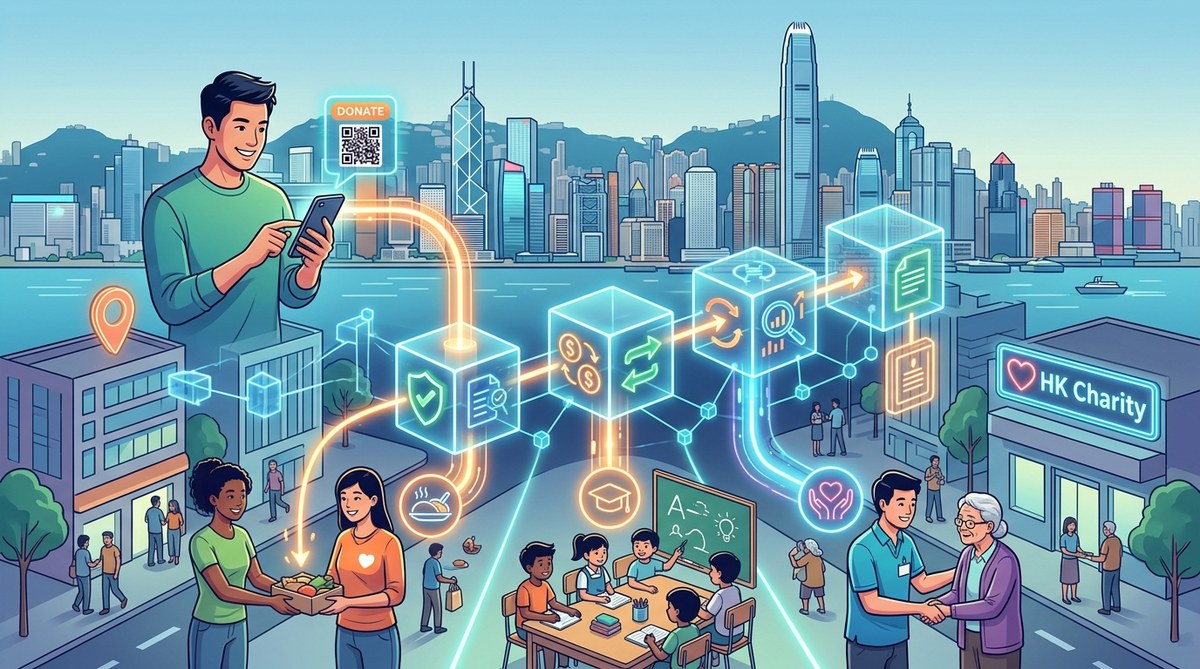
In Hong Kong, trust is the currency that fuels charitable giving. Yet recent years have shown that trust can be fragile. When donors give money to a cause, they want to know where every dollar ends up. This is where blockchain enters the picture. The technology behind cryptocurrencies offers something the charity sector desperately needs: an unchangeable, public record of every transaction. For NGO professionals and tech enthusiasts in Hong Kong, the question is no longer whether blockchain can improve transparency. The question is how to make it work here, in one of Asia’s most dynamic philanthropic hubs. This article lays out the practical path.
Blockchain technology offers Hong Kong charities a way to rebuild donor trust through transparent, tamper-proof donation tracking. By recording every transaction on a shared public ledger, NGOs can show exactly how funds are used from donation to final impact. For researchers and tech enthusiasts exploring blockchain transparency in Hong Kong’s charity sector, this guide covers practical implementation steps, common pitfalls to avoid, and explains why 2026 is the ideal time to adopt this transformative approach.
The transparency challenge facing Hong Kong charities today
Hong Kong has one of the most generous donor communities in Asia. In 2025, charitable donations in the city reached new heights, with major contributions flowing to disaster relief, education, and social services. But generosity comes with a demand for accountability.
Several high profile incidents have shaken public confidence. Funds that were meant for community programs ended up covering administrative costs. Reports of mismanagement surfaced across both small NGOs and larger charitable organisations. Donors started asking harder questions. Where did my money go? How much actually reached the people in need?
The core problem is simple. Traditional financial reporting relies on trust in the organisation. An NGO publishes an annual report with numbers and stories. Donors have no way to verify those numbers independently. The system works on faith. And faith, as we have seen, can be broken.
- No real time visibility into fund flows
- Manual record keeping that is prone to error and manipulation
- High administrative costs for auditing and compliance
- Donor fatigue caused by vague impact reporting
- Limited ability to track funds across multiple intermediaries
These are not small issues. They affect every charity operating in Hong Kong, from neighbourhood based groups to international agencies with local offices. The need for a better system is urgent. And that is exactly what blockchain can provide.
How blockchain creates a trust layer for donations
Think of a blockchain as a digital notebook that everyone can see but no one can erase. Every time a donation is made, a record is added to the chain. That record includes the amount, the date, the sender, and the recipient. Once written, it cannot be changed or deleted. Anyone with access to the chain can verify every entry.
For charities, this means donors can track their contributions in real time. They see when the money leaves their account, when it arrives at the NGO, and when it is spent on a specific program. The entire journey is visible.
“Blockchain does not just make charity transparent. It makes transparency automatic. You no longer need to ask where the money went. You can see it yourself, on a public ledger that cannot be faked.” – Dr. Mei Ling Chan, Researcher in Distributed Ledger Technology, University of Hong Kong
This is a fundamental shift. Instead of relying on annual reports and audited statements, donors get live access to the data. They can verify impact without waiting for a quarterly update. And because the records are shared across many computers, no single person or organisation can alter them.
For Hong Kong charities, the benefits go beyond donor trust. Blockchain can reduce administrative overhead by automating reconciliation and reporting. Smart contracts – self executing agreements on the blockchain – can release funds automatically when certain conditions are met. An education charity, for example, could set up a smart contract that releases scholarship money only after a student confirms attendance. No middleman needed. No delay.
A practical guide to implementing blockchain for donation tracking
Moving from theory to practice requires a clear plan. Here are the steps a Hong Kong charity can follow to start using blockchain for transparency.
-
Select a suitable blockchain platform. Ethereum is the most widely used for charitable applications, but other options like Polygon, Solana, or Hyperledger Fabric may offer lower fees and faster transactions. Choose based on your transaction volume and budget.
-
Set up a digital wallet for the organisation. This wallet will receive donations and send funds to programs. Use a multi-signature wallet to require approval from multiple board members for large transactions. This adds a layer of security and shared accountability.
-
Integrate a donation tracking interface on your website. Tools like The Giving Block and Charity Wall offer plug and play solutions that connect your donation page to the blockchain. Donors receive a transaction ID with each gift, which they can use to view the record on a public explorer.
-
Train your staff and board members. Blockchain terminology can be confusing. Run internal workshops to explain how the system works, how to read transaction records, and how to answer donor questions. Make sure everyone understands the value of transparency.
-
Publish your blockchain address publicly. Share your wallet address on your website and in your marketing materials. This allows anyone to verify incoming donations and outgoing expenses. It turns your financial operations into an open book.
-
Report impact with on-chain data. When you complete a program, publish a report that links each expense to a transaction on the blockchain. Donors can then match the funds they gave with the outcomes achieved. This creates a direct line between contribution and impact.
These steps are not theoretical. Organisations around the world have already implemented them. In 2024, a consortium of Southeast Asian charities launched a blockchain based donation tracking system that serves over 200 NGOs. The same model can work in Hong Kong.
Common implementation pitfalls to avoid
Adopting blockchain is not without challenges. Many charities make mistakes in the early stages. Knowing what to watch for can save time, money, and credibility.
| Common Mistake | Better Approach |
|---|---|
| Choosing a platform based on hype rather than practical fit | Evaluate platforms based on transaction fees, speed, and ease of use for your specific needs |
| Ignoring the learning curve for staff and donors | Invest in training and create simple guides in both English and Chinese |
| Treating blockchain as a standalone solution | Integrate blockchain with your existing financial systems and reporting processes |
| Overlooking data privacy regulations in Hong Kong | Ensure compliance with the Personal Data (Privacy) Ordinance when recording transaction data |
| Expecting immediate adoption from donors | Start with a pilot program and gather feedback before scaling up |
The table above highlights the most common issues. The biggest mistake is thinking that blockchain alone solves everything. Technology is a tool. It works best when combined with strong governance, clear communication, and a genuine commitment to openness.
Another mistake is underestimating the cost. While some blockchains offer free transactions, others charge fees that vary with network traffic. For a small NGO processing many small donations, these fees can add up. Plan your budget accordingly and consider layer 2 solutions that reduce costs.
Why 2026 is the right time for Hong Kong charities to act
The stars are aligning for blockchain adoption in Hong Kong’s charity sector. Three factors make 2026 a turning point.
First, the technology has matured. Early blockchain projects suffered from slow speeds, high costs, and complicated user interfaces. Those problems are largely solved. Modern platforms can handle thousands of transactions per second at minimal cost. User friendly wallets and interfaces make the experience smooth for non-technical users.
Second, regulatory clarity is improving. The Hong Kong government has shown increasing interest in blockchain technology. The Securities and Futures Commission has issued clear guidelines for digital assets. While charity specific regulations are still evolving, the overall direction is supportive. Charities that start now will be ahead of the curve when formal standards emerge.
Third, donor expectations are shifting. A new generation of donors in Hong Kong expects transparency as a standard, not a bonus. They grew up with digital tools and instant access to information. They want to see where their money goes, in real time, without having to ask. Charities that offer this level of openness will attract more support. Those that do not will struggle to compete.
For a deeper look at how technology is reshaping the social sector, read our piece on how technology is revolutionising social services in Hong Kong. It covers the broader digital transformation that blockchain is part of.
Real tools that make blockchain transparency work today
You do not need to build a custom blockchain from scratch. Several platforms and tools are ready to use right now. Here are three that are particularly well suited for Hong Kong charities.
Charity Wall is a platform designed specifically for non profit organisations. It issues a transaction certificate for each donation, which donors can view on a public dashboard. The certificate includes the donation amount, the date, and the project it supports. Charity Wall has been used by organisations in Europe and Asia, and its model is adaptable to Hong Kong’s regulatory environment.
The Giving Block connects charities with cryptocurrency donors. It handles the technical side of accepting Bitcoin, Ethereum, and other digital currencies, and converts them to fiat for the charity. The platform also provides tax receipt generation, which is useful for donors in jurisdictions that recognise cryptocurrency donations.
AidChain is a newer entrant focused on aid distribution. It tracks funds from donor to beneficiary, with each step recorded on the blockchain. AidChain is particularly useful for charities that work through multiple intermediaries, such as disaster relief organisations that partner with local groups on the ground.
These tools are not perfect. Each has limitations in terms of cost, complexity, and geographic coverage. But they are functional, proven, and available now. For a Hong Kong charity looking to start, the best approach is to pick one platform, run a trial with a single program, and iterate from there.
If you are evaluating different digital solutions for your organisation, you may also find our guide on essential tech tools every Hong Kong nonprofit should implement helpful. It covers a range of technologies beyond blockchain that can improve your operations.
Building a transparent future for Hong Kong philanthropy
Blockchain transparency in Hong Kong’s charity sector is not a distant possibility. It is a practical step that organisations can take today. The technology exists. The tools are ready. The donors are waiting.
What it requires is leadership. Board members and executive directors need to make a conscious decision to open their books. Staff need to learn new skills. Processes need to be redesigned. It is work. But the payoff is enormous.
A charity that adopts blockchain transparency gains more than donor trust. It gains credibility, efficiency, and a competitive edge. In a city where hundreds of organisations compete for the same donation dollars, being the one that offers real, verifiable transparency is a powerful differentiator.
Start small. Pick one program. Set up a wallet. Publish your transactions. Show your donors exactly what happened with their money. Let them see the impact they helped create. Then expand from there.
The future of charitable giving in Hong Kong is transparent. Blockchain is the tool that gets us there. And the time to start is now.
For more insights on how to strengthen your organisation through technology, visit our page on harnessing technology to boost transparency in Hong Kong charities. It offers additional strategies and case studies that complement what we have covered here.
If you are thinking about the longer term direction of the sector, our article on the future of nonprofit transparency in Hong Kong’s social sector provides a forward looking view that connects blockchain with broader trends in governance and accountability.