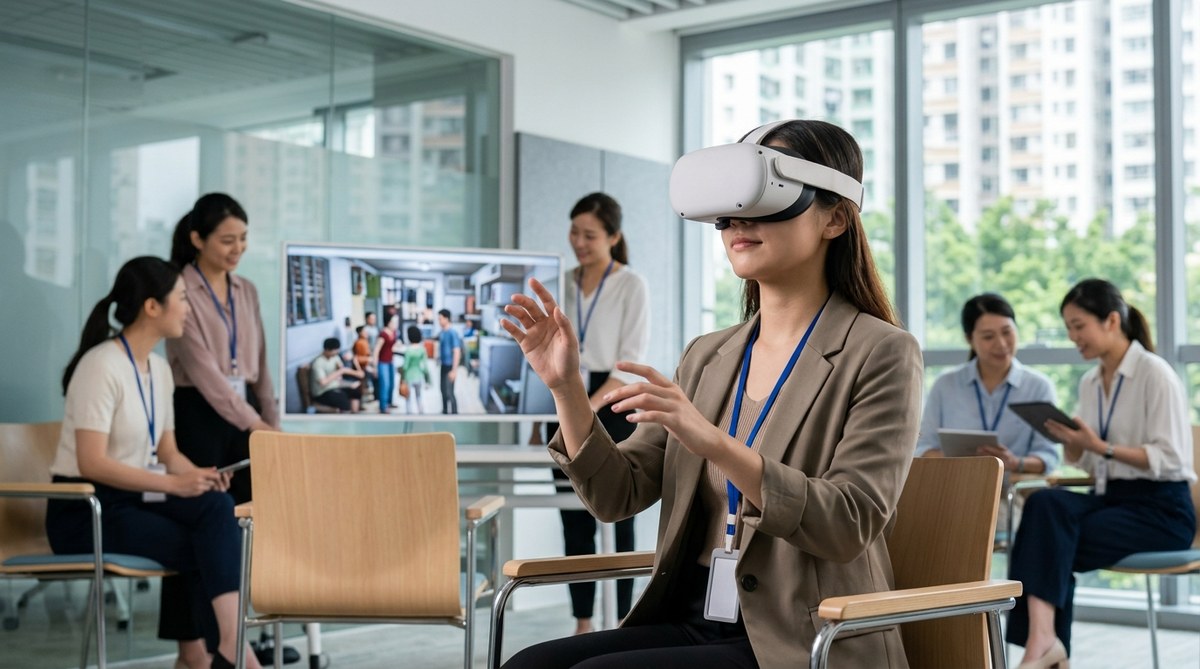
Picture a social worker in Hong Kong sitting across from a teenager who has just aged out of a group home. The teenager is angry, scared, and struggling to articulate their pain. The social worker wants to connect, but the gap between their own stable upbringing and the teen’s chaotic life feels enormous. Now imagine that same social worker has already stood in the teenager’s shoes – inside a virtual reality scenario that recreated the experience of being alone in a subdivided flat with no family support. That changed everything. Virtual reality (VR) is no longer just for gaming. It is becoming one of the most powerful tools for building empathy in social work, and Hong Kong’s agencies are starting to take notice.
VR training for social workers empathy allows practitioners to inhabit a client’s lived reality – from caring for elderly relatives in cramped quarters to navigating mental health stigma in a competitive city. By immersing workers in these perspectives, agencies in Hong Kong can reduce burnout, improve case outcomes, and strengthen trust with vulnerable communities. This guide explains how to start.
Why Hong Kong Social Workers Need VR Empathy Training
Hong Kong’s social workers face pressures that are unique to this city. Long shifts, high caseloads, and the emotional toll of hearing trauma stories day after day can lead to compassion fatigue. At the same time, clients often feel that professionals “just don’t get it.” A young mother living in a subdivided unit may hear advice about “stress management” from a caseworker who has never experienced such living conditions. That gap in understanding hurts the therapeutic relationship.
VR closes that gap. Instead of reading a case note or watching a video, a social worker can spend ten minutes inside a simulated environment that mirrors a client’s daily reality. Studies from institutions like Stanford have shown that VR experiences produce stronger emotional and cognitive responses than traditional training. The result is not just sympathy – it is genuine empathy, built through embodied experience.
Hong Kong agencies that adopt VR training can see immediate improvements. Workers feel more prepared. Clients report feeling heard. And the overall quality of care rises.
How VR Builds Empathy in Social Work Practice
Empathy is often described as “walking in someone else’s shoes.” VR makes that literal. Using a headset, a social worker can become a character who faces the same barriers as a client. For example, a scenario might simulate the auditory hallucination of schizophrenia, or the overwhelming feeling of being stared at because of a physical disability. The worker’s own brain registers these experiences as real, which activates the same neural pathways involved in real empathy.
Key benefits include:
- Reduced stigma around mental health conditions
- Greater patience and understanding with challenging behaviours
- Improved ability to pick up on non-verbal cues
- Lower emotional exhaustion because workers feel more competent
- Stronger trust between worker and client
VR also allows for safe practice. A worker can make mistakes in a simulation – say the wrong thing, miss a cue – and learn from it without harming a real client. This kind of experiential learning is far more effective than roleplay in a classroom.
Practical Steps to Start VR Training in Your Agency
If you are a social work educator or a manager at a Hong Kong NGO, here is a process to get started. Adapt it to your budget and team size.
-
Identify the specific empathy gaps in your team. Do workers struggle with elderly end-of-life conversations? With youth who self-harm? With domestic violence survivors? Choose one or two key scenarios to start.
-
Select a VR platform or partner. You can buy off the shelf software designed for social work (like Embodied Labs or the RIVRT training from the UK) or work with a local tech company like Cornerstone VR to customise scenarios that reflect Hong Kong’s environment – think cramped public housing, crowded MTR stations, or the unique stresses of cross-border families.
-
Prepare your hardware. You will need a few VR headsets (Meta Quest 3 or similar) and a quiet space with enough room for movement. Budget around HKD 4,000–5,000 per headset.
-
Run a pilot session with 3 to 5 experienced workers. Let them experience the VR scenario and then lead a debrief using a structured empathy reflection worksheet.
-
Measure the impact. Use pre-and post-training surveys that assess empathy levels (standardised tools like the Toronto Empathy Questionnaire). Also track qualitative feedback: “What did you feel that you wouldn’t have learned from a lecture?”
-
Scale up. Once the pilot proves successful, roll VR training into your annual professional development calendar. Consider offering it to interns and new hires.
Techniques and Common Mistakes in VR Empathy Training
The following table contrasts effective techniques with pitfalls to watch out for. Use it when designing your own programme.
| Effective Technique | Common Mistake |
|---|---|
| Pair VR experience with guided debrief by a trained facilitator | Letting workers try VR alone with no follow-up discussion |
| Start with short scenarios (5–7 minutes) to avoid overwhelm | Using long, intense simulations that cause distress without support |
| Customise scenarios to Hong Kong contexts (e.g., Sham Shui Po subdivided flats) | Using generic Western housing or hospital settings that feel alien |
| Combine VR with traditional roleplay for deeper learning | Replacing all other training methods with VR only |
| Ask workers to journal their emotional responses right after the simulation | Skipping the reflection step because of time pressure |
| Ensure privacy during sessions to reduce embarrassment | Having the whole office watch the simulation on a monitor |
A common worry is that VR might feel “gimmicky.” That is why facilitator quality matters. As one training expert puts it:
“VR is the mirror, not the teacher. The real learning happens when a skilled supervisor helps the worker unpack what they saw, felt, and thought. Without that conversation, it is just a cool video game.”
Real Examples of VR in Hong Kong Social Work
Several organisations are already paving the way. The Hong Kong Council of Social Service has piloted VR modules for frontline workers dealing with elderly cognitive decline. The worker wears a headset that simulates macular degeneration and hearing loss, so they understand why an elderly client might seem “confused” when they cannot see or hear properly. Another pilot, run by a local mental health NGO, uses VR to show the experience of being sectioned under the Mental Health Ordinance – helping staff understand the fear and confusion of involuntary admission.
These examples show that VR is not about replacing human warmth. It is about giving workers a second set of eyes. Once they have truly seen a client’s world, their empathy becomes instinctive, not forced.
For broader context on how technology is reshaping the sector, read our guide on how technology is revolutionising social services in Hong Kong. It covers the full digital toolkit that complements VR training.
Addressing Barriers to Adoption in Hong Kong
Cost is the first concern. But VR headsets have dropped in price dramatically. A single headset can serve an entire team over a year. Consider applying for grants from the Government’s Innovation and Technology Fund or community trust funds. Another barrier is technical confidence. Many senior social workers are not comfortable with gadgets. The solution is simple: have a younger colleague or a tech volunteer set up the equipment and run the first session. Peer support works wonders.
Then there is the cultural dimension. Hong Kong clients may feel embarrassed or suspicious if their social worker suddenly puts on a headset. Transparency is key. Explain that the worker is learning how to be a better helper. In fact, some agencies invite clients to try the VR experience themselves after the worker has been trained. That builds mutual understanding.
For a step-by-step look at building a digitally resilient agency, our guide on 10 steps to building a digital-first social service agency in Hong Kong offers practical advice that pairs well with VR adoption.
The Future of VR for Social Workers Empathy in Hong Kong
By 2026, more universities in Hong Kong are expected to integrate VR into their social work curricula. The University of Hong Kong and Chinese University already run experimental labs. In the next three years, we will likely see shared VR libraries where multiple agencies pool resources to access a variety of scenarios. AI will also enhance VR by adapting scenarios in real time based on the worker’s choices. Imagine a simulation that notices you tend to avoid direct eye contact with a domestic violence survivor, then adjusts the dialogue to give you more practice.
For social workers who feel overwhelmed by the city’s relentless pace, VR training for social workers empathy offers a moment of stillness. It asks you to slow down and feel what another person feels. That is a radical act in a world that demands speed.
If you are an educator or a manager, start small. Borrow a headset from a university or rent one for a day. Let your most curious team member try a free demo. Then have a conversation about what you saw. That first step is all it takes to begin closing the empathy gap.
For more insights on how digital tools are transforming charities in Hong Kong, visit our article on top nonprofit management platforms transforming social services in Hong Kong. It explains the broader ecosystem that VR is part of.
Building Empathy Together
VR training for social workers empathy is not a silver bullet. It works best when combined with reflective supervision, peer support, and genuine care for the people we serve. But it is a tool that can awaken something in even the most experienced worker: the feeling of truly being with someone. In a city as dense and demanding as Hong Kong, that feeling matters more than ever. Give it a try with your team. The families you serve will notice the difference.