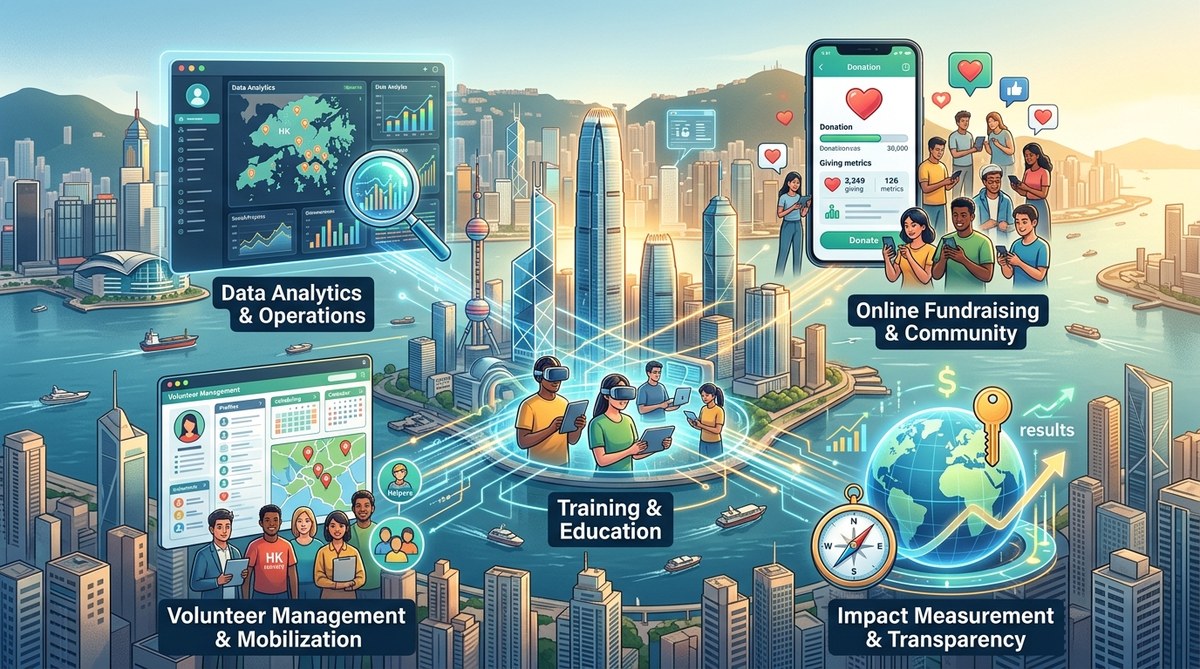
In Hong Kong, the gap between social need and available resources keeps growing. Yet a new wave of social enterprises is finding ways to do more with less. They are turning to technology not as a gimmick, but as a practical tool to reach more people, cut costs, and measure what actually works. From AI-powered counselling chatbots to blockchain-verified donation systems, these organisations are proving that doing good and using smart tech can go hand in hand.
Hong Kong social enterprises are using five key technologies to scale impact: AI for personalised service delivery, cloud platforms for operational efficiency, blockchain for donor trust, mobile apps for community engagement, and data analytics for evidence-based decision making. Each approach solves a specific bottleneck that has traditionally limited social impact in the city.
Five Technologies Reshaping Social Impact in Hong Kong
The social enterprise scene in Hong Kong has always been resourceful. But in 2026, the most effective organisations are no longer just working harder. They are working smarter by adopting specific technologies that match their mission.
Here is a look at the five main ways Hong Kong social enterprises using tech are achieving real scale.
1. AI for Personalised Service Delivery
Artificial intelligence is helping social enterprises deliver one-to-one support without needing a one-to-one staff ratio. A growing number of mental health social enterprises in Hong Kong now use AI chatbots to provide initial triage for users. These bots handle common questions, offer coping strategies, and flag urgent cases for human counsellors.
One example is a local social enterprise that supports elderly residents living alone in public housing estates. They deployed a Cantonese-language voice assistant that checks in with users daily. The system asks about medication, mood, and safety. If it detects a problem, it alerts a case worker. This simple AI tool lets one social worker monitor 200 clients instead of 30.
“We used to spend 80% of our time on routine check-ins. Now we spend that time on actual intervention. The tech does the listening; we do the helping.” – Programme Director, Hong Kong elderly care social enterprise
For more on this topic, read our guide on how Hong Kong nonprofits can leverage AI to enhance service delivery in 2026.
2. Cloud Platforms for Operational Efficiency
Many social enterprises run on shoestring budgets. Cloud-based management systems are changing that by removing the need for expensive IT infrastructure. A social enterprise running job training programmes for ethnic minorities in Kowloon moved its entire case management system to the cloud last year. The result was a 40% reduction in administrative time.
The practical steps to adopt cloud tools look like this:
- Audit your current workflow. Map every repetitive task that eats up staff time.
- Choose a platform that fits your size. A small team does not need an enterprise system.
- Train your team in stages. Roll out one module at a time to avoid overwhelm.
- Integrate with existing tools. Make sure the new system talks to your email and calendar.
- Review after three months. Check if the tool is actually saving time or creating new work.
For a full list of platforms, see our article on top nonprofit management tools transforming social work in Hong Kong.
3. Blockchain for Donor Trust
Trust is the currency of the social sector. Hong Kong donors, especially younger ones, want to know exactly where their money goes. Several local social enterprises are now using blockchain-based ledgers to record every transaction. Donors can see their contribution move from their wallet to a specific programme in real time.
This matters because a 2025 survey by a local university found that 68% of Hong Kong donors said transparency was their top concern when choosing a charity. Blockchain solves that problem by making data tamper-proof.
A food redistribution social enterprise in Chai Wan uses this system. Every dollar donated is tracked. When a donor gives HKD 100, they can see that HKD 85 bought fresh vegetables and HKD 15 covered logistics. No guesswork. No suspicion.
Learn more about why Hong Kong donors are demanding blockchain transparency in 2026.
4. Mobile Apps for Community Engagement
Hong Kong has one of the highest smartphone penetration rates in the world. Social enterprises are using this to build engaged communities. A social enterprise focused on youth mental health created a mobile app where users can join anonymous support groups. The app uses gamification to encourage daily check-ins. Users earn points for sharing coping strategies or supporting others.
The app now has 50,000 active users in Hong Kong. That is a scale no single physical centre could achieve.
Here are common mistakes social enterprises make when building a community app:
| Mistake | Why It Hurts | Better Approach |
|---|---|---|
| Building for everyone | App becomes generic, pleases no one | Define one core user persona first |
| Ignoring local language | Cantonese voice and text support is missing | Prioritise Cantonese from day one |
| Overcomplicating features | Users get confused and abandon the app | Launch with one feature, add more later |
| No offline integration | App feels disconnected from real services | Link app data to in-person follow-ups |
| Skipping user testing | You build what you think, not what they need | Test with 20 real users before launch |
For practical advice, check 5 ways nonprofits in Hong Kong are using mobile apps to engage donors.
5. Data Analytics for Evidence-Based Decisions
Good intentions are not enough. Funders and government bodies in Hong Kong increasingly demand proof of impact. Social enterprises that use data analytics can show exactly what works and what does not.
A social enterprise running after-school programmes for underprivileged children in Sham Shui Po started using a simple analytics dashboard. They track attendance, test scores, and feedback in one place. The data showed that students who attended at least 80% of sessions improved their English scores by 30%. That evidence helped them secure a three-year government grant.
The tools do not need to be expensive. A combination of Google Data Studio and a shared spreadsheet can already provide powerful insights for a small team.
For a deeper look, read how Hong Kong social services can use data analytics to improve impact in 2026.
Choosing the Right Technology for Your Mission
Not every technology fits every social enterprise. The key is to match the tool to the problem you are trying to solve. Here is a simple framework:
- If your bottleneck is staff capacity, look at AI and automation.
- If your bottleneck is donor trust, look at blockchain.
- If your bottleneck is community reach, look at mobile apps.
- If your bottleneck is operational chaos, look at cloud platforms.
- If your bottleneck is proving impact, look at data analytics.
Some technologies are best combined. For example, a social enterprise that uses a cloud platform for case management can feed that data into an analytics dashboard to produce grant reports automatically. That saves even more time.
To help you evaluate your options, use this checklist:
- Does the technology serve the mission, or are we forcing a fit?
- Can our team actually use it without extensive training?
- What is the total cost, including maintenance and updates?
- Does the vendor understand Hong Kong’s regulatory environment?
- How will we measure success after implementation?
For a full evaluation framework, see a guide for Hong Kong social workers on choosing the right tech stack in 2026.
The Path Forward for Hong Kong Social Enterprises Using Tech
The social enterprise sector in Hong Kong is at a turning point. The demand for services is rising. The funding environment remains tight. But technology offers a way forward that does not require massive budgets. It requires clear thinking, a willingness to try new tools, and a focus on what actually moves the needle.
The most successful organisations in 2026 are not the ones with the fanciest tech. They are the ones that start small, test honestly, and scale what works. A chatbot that helps ten elderly people today can be refined to help a thousand tomorrow. A donation tracking system that builds trust with one donor can be shared across an entire network.
If you are a researcher, social entrepreneur, or policy advisor, the message is simple. The tools exist. The examples are here. The next step is to pick one area where technology can make a difference in your work and start experimenting. You do not need to transform everything at once. One small change, done well, can create a ripple effect that reaches far beyond your initial expectations.
For more resources on this topic, visit our collection on empowering Hong Kong’s social services with innovative technology solutions.