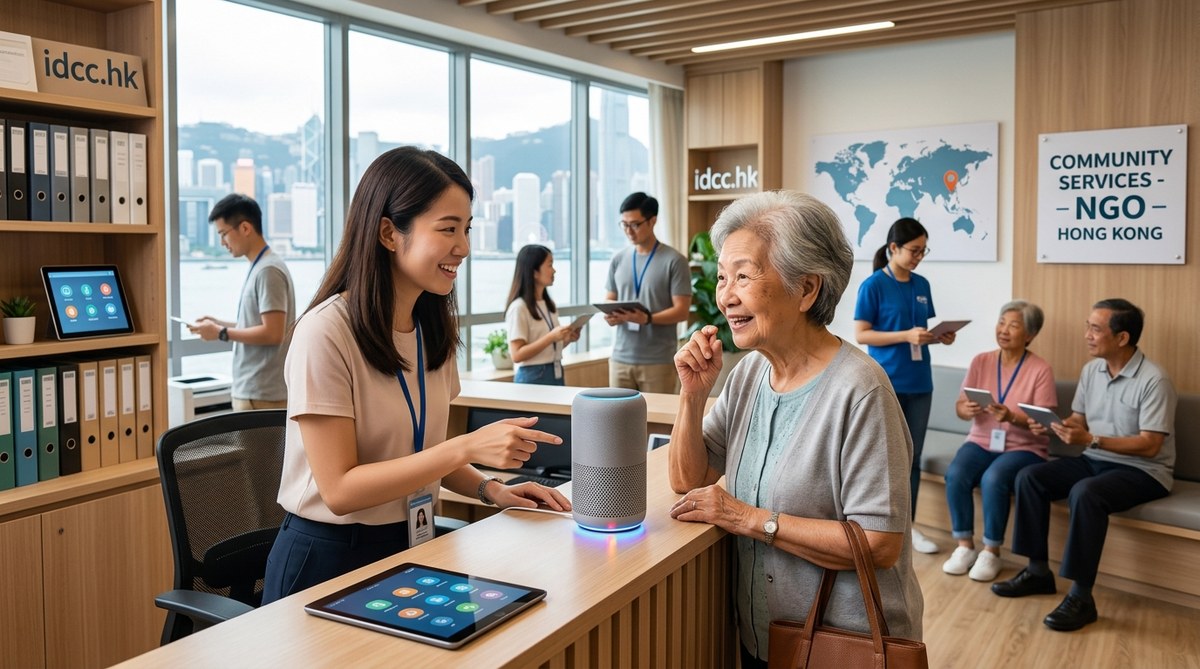
Can you imagine a client getting the help they need just by speaking out loud? No forms to fill. No apps to navigate. Just a natural conversation that connects them to the right service. For many Hong Kong NGOs, this is not a futuristic dream. Voice-activated service delivery is here now, and it is changing how organisations reach vulnerable communities.
Voice-activated service delivery helps Hong Kong NGOs serve clients faster, especially those with low digital literacy or visual impairments. By using simple voice commands, organisations can automate intake, answer FAQs, and schedule appointments. This guide covers the practical steps, common pitfalls, and real tools to get started in 2026.
Why Voice Matters for Hong Kong Social Services
Hong Kong has one of the highest smartphone penetration rates in the world. Yet many of the people your NGO serves struggle with digital interfaces. Elderly residents, migrant workers, and individuals with disabilities often find touchscreens and small text frustrating. Voice technology removes that barrier.
Think about a senior citizen living in a subdivided flat in Sham Shui Po. She needs to check her meal delivery schedule. Instead of calling a busy hotline or downloading an app, she simply says, “When is my next meal?” into a smart speaker or her phone. The system replies instantly. That is dignity. That is efficiency.
Voice-activated service delivery is not about replacing human staff. It is about freeing them up. When a voice assistant handles repetitive questions, your social workers can focus on complex cases that need empathy and judgment.
How Voice-Activated Delivery Works for NGOs
Voice technology for NGOs typically follows a simple flow. A user speaks into a device. The speech is converted to text. An AI system interprets the intent. Then it triggers an action, like looking up a record or sending a reminder.
Here are the core components you need to understand:
- Speech-to-text engine: Converts Cantonese or English speech into written words.
- Natural language processing (NLP): Understands what the person means, not just the exact words.
- Backend integration: Connects to your case management or CRM system.
- Response generation: Speaks back to the user in a natural voice.
Hong Kong NGOs often serve multilingual populations. A good voice system can handle Cantonese, Mandarin, and English. This is critical in a city where code-switching is common.
A Practical 4-Step Process to Get Started
If you are a program manager or digital lead, here is a structured way to approach voice-activated service delivery for your organisation.
-
Identify the highest-volume, lowest-complexity task. Look at your current service data. Which questions do clients ask most often? Appointment booking, service hours, application status, or transport arrangements? Start with one simple use case. Do not try to automate everything at once.
-
Choose a voice platform that supports Cantonese. Not all AI voice tools handle Cantonese well. In 2026, major providers like Google Cloud Speech-to-Text, Azure AI, and local vendors offer Cantonese support. Test the accuracy with your actual staff and clients before committing.
-
Map the conversation flow. Write out every possible way a client might ask for the same thing. For example, “I need to see a counsellor”, “Book a session”, and “When can I talk to someone?” should all lead to the same booking process. Use a simple decision tree.
-
Integrate with your existing systems. Voice commands are useless if they cannot pull data from your database. Work with your IT team or vendor to connect the voice layer to your case management software. This is where how Hong Kong social services can use data analytics to improve impact in 2026 becomes directly relevant.
Common Mistakes and How to Avoid Them
Even well-funded NGOs stumble when rolling out new technology. Here is a table that contrasts common mistakes with better approaches.
| Mistake | Better Approach |
|---|---|
| Building for English first, then adding Cantonese later | Build for Cantonese from day one. Your clients speak it. |
| Assuming all users will speak clearly | Design for background noise, mumbling, and heavy accents. |
| Forgetting about privacy compliance | Voice data is personal data. Follow Hong Kong’s PDPO guidelines. |
| Launching without testing with real clients | Pilot test with 10 to 20 actual service users before full rollout. |
| Making the voice system too chatty | Keep responses short. Clients want answers, not conversation. |
“The biggest mistake I see is NGOs treating voice as a tech project instead of a service design project. You have to start with the client’s experience, not the software.”
Samantha Lee, Digital Transformation Consultant for Asian Social Enterprises
Real Use Cases for Hong Kong NGOs
Voice-activated service delivery is not abstract. Here are concrete examples already working in the field.
Elderly care hotlines. A voice assistant answers calls from seniors who need to confirm their home helper schedule. The system checks the database and confirms the time in Cantonese. If the senior sounds confused, it transfers to a human operator.
Youth counselling intake. Teenagers often hesitate to type out their problems. A voice system lets them speak privately about mental health concerns. The system triages urgency and routes the conversation to the right counsellor. This builds on what how Hong Kong social services are using chatbots to streamline client intake started.
Disability support services. For clients with visual impairments or limited hand mobility, voice is the only accessible digital channel. They can check transport availability, request sign language interpreters, or report issues without needing to see a screen.
Volunteer coordination. Volunteers call a voice line to log their hours, check upcoming shifts, or report last-minute cancellations. This reduces the admin burden on coordinators. It aligns with 5 ways digital tools are enhancing volunteer coordination for Hong Kong nonprofits.
What to Look for in a Voice Platform in 2026
The market for voice AI has matured. You no longer need a massive budget. Here are the features to prioritise when evaluating vendors.
- Cantonese language support with high accuracy. Ask for a demo using real recordings of your staff and clients.
- Custom vocabulary. Your NGO has its own terms. The system must learn words like “subsidised housing”, “caseworker”, or “rehabilitation programme”.
- Fallback to human. When the AI does not understand, it must transfer seamlessly to a person without the client repeating themselves.
- Analytics dashboard. You need to see what clients are asking about most. This helps you improve services over time.
- Data localisation. Ensure the voice data is stored in Hong Kong or a jurisdiction that meets your compliance needs.
If you are still building your overall digital strategy, start with essential tech tools every Hong Kong nonprofit should implement before adding voice.
Measuring Success
How do you know voice-activated delivery is working? Track these metrics from month one.
- Call deflection rate. What percentage of calls are fully handled by voice without needing a human?
- User satisfaction score. Survey clients after their voice interaction. Keep it simple. “Did you get what you needed?”
- Average handling time. Compare the time a voice interaction takes versus a phone call or in-person visit.
- Error rate. How often does the system misunderstand or fail to complete a task?
- Cost per interaction. Voice is often cheaper per interaction than a staffed hotline. Track the savings.
Preparing Your Team for the Shift
Technology adoption fails when people are left out. Your frontline staff may worry that voice AI will replace them. Be transparent. Explain that voice handles the repetitive, low-touch tasks so they can do more meaningful work.
Run training sessions where staff can interact with the voice system themselves. Let them see its limits. When they understand what it can and cannot do, they will trust it more. This is part of the broader work of why Hong Kong’s social service agencies need a digital transformation strategy.
Also involve your clients in the design. If you serve elderly communities in Sai Kung or families in Wong Tai Sin, ask them what phrases they would naturally use. Their language should shape the system, not the other way around.
Your First Step This Week
You do not need a full rollout to start. Here is one action you can take today.
Pick one service that generates the most repetitive phone calls. Write down the top five questions clients ask. Then record yourself or a colleague asking those questions in Cantonese. Play the recording into a free voice-to-text tool like Google’s or Azure’s demo. See how accurately it transcribes.
If the accuracy is above 80 percent, you have a viable starting point. If it is lower, you know you need a custom model or a vendor that specialises in Cantonese.
From there, move to a small pilot. Use a tool like Twilio’s Voice API or a local platform that offers Cantonese support. Test with five staff members for one week. Then expand to ten clients for one month.
Voice as a Bridge, Not a Barrier
Voice-activated service delivery is not about chasing trends. It is about meeting your clients where they are. For many Hong Kongers, speaking is easier than typing. For others, it is the only option.
By adopting this technology thoughtfully, your NGO can serve more people with the same resources. You can reduce wait times. You can improve client dignity. And you can give your team the breathing room they need to do their best work.
The question is no longer whether voice will become part of social services. It already is. The question is whether your organisation is ready to lead or will be left catching up.
Start small. Test honestly. Listen to your clients. That is how you make Hong Kong NGO voice service delivery work in the real world.